
What are perimenopause and menopause?
Perimenopause and menopause are, by nature, about change. Levels of the sex hormones estrogen and progesterone begin to fluctuate during perimenopause, triggering a complex, interconnected network of changes that manifest as symptoms spanning women's reproductive, cardiometabolic, cognitive, physical, and emotional experience. Complicating this further is the fact that there is no reliable test to validate the onset of perimenopause. Consequently, it is often diagnosed on a suspected basis, and only after a woman has accumulated multiple symptoms over a sustained period of time.
While more clearly defined, menopause is also confirmed with a retrospective lens, declared after a woman has gone a full year without menstruating.
This lack of clarity within the medical establishment has a significant impact on the care and support women ultimately receive. Many women remain unaware of the wide range of symptoms associated with these changes and view them as isolated irritations, rather than symptoms that can often be managed with informed care. Even when women do seek assistance, the support offered varies widely across health systems, regions, and from one doctor to another.
Skin changes during perimenopause and menopause
Both perimenopause and menopause lead to a range of effects on the skin. This overview outlines common skin changes and related drivers during perimenopause and menopause.
| Skin change | Perimenopause | Menopause |
|---|---|---|
| Overall trend | Unpredictable – symptoms appear and fade as estrogen and progesterone fluctuate | Steady and cumulative – changes build gradually as estrogen settles at a sustained low level |
| Sensitivity & redness | Common – flushing and rosacea flares tied to vasomotor instability, as erratic hormone swings affect blood vessel signalling in the skin | Vasomotor flushing can persist, now driven by sustained low estrogen rather than swings, and redness increasingly pairs with dryness as the skin's cushioning thins |
| Breakouts | Can increase for some women – hormonal fluctuation can trigger more sebum production, often compounded by higher cortisol and poorer sleep reducing your skin’s regeneration time | Uncommon – sebaceous gland activity and sebum production typically decline |
| Hydration | May increase or decrease as sebum and barrier lipid levels fluctuate alongside hormones | Progressively drier, as declining sebum, hyaluronic acid, and barrier lipids reduce the skin's ability to hold onto moisture |
| Itching | Can occur alongside early dryness and sensitivity as hormones start to fluctuate | Very common – pruritus is reported as one of the most frequent skin among menopausal women, tracking closely with progressive dryness and barrier thinning |
| Firmness & elasticity | Minimal noticeable change – collagen and elastin support remain largely intact | Gradually reduced, as declining estrogen slows collagen renewal and increases activity of the enzymes that break it down |
| Healing & regeneration | Largely unaffected | Slower, as reduced blood flow, fewer estrogen receptors in skin’s structural cells, and increased oxidative stress limit the skin's ability to repair and renew |
Table 1. Common skin changes during perimenopause and menopause. Bioli, 2026.
The science behind skin changes
The article “Decoding the Impact of Ageing and Environment Stressors on Skin Cell Communication,” explains that the cellular structures that make up our skin function like a complex communications network, “continuously sending and receiving messages.” In women, estrogens interact directly with two key types of structural cells, both of which carry estrogen receptors: the keratinocytes in the epidermis, the skin's outer layer; and fibroblasts in the dermis, the layer below the epidermis.
Keratinocytes produce the protein keratin, which helps to keep water in, and protects against environmental stressors, such as pathogens and pollution. It also supports wound healing, immune and inflammatory responses.
Fibroblasts maintain the integrity of the structure beneath the epidermis by synthesizing and remodelling collagen as part of the wound healing process, and building and maintaining elastin. These cells produce chains of molecules that attract water, like hyaluronic acid, supporting skin hydration and cushioning.
When these cells lose consistent access to estrogen their ability to build keratin, produce collagen and elastin, and generate the water-binding molecules described above all suffer together. That's why skin changes during this transition tend to show up as a cluster of related effects, rather than one isolated symptom.
What you can do
A review of intrinsic and extrinsic factors in skin aging, published in the International Journal of Cosmetic Science, found that sun exposure is estimated to account for up to 90% of visible skin aging, particularly in those with lower levels of melanin-producing protection in the skin. This points to the idea that while the hormonal changes discussed are normal, the unwanted effects of these healthy changes can be influenced by our actions, and their impact reduced.
Steps you can take – Skincare
- Protect your skin from UV rays – UV exposure is one of the most significant external contributors to visible skin aging, and its effects compound with the structural changes already underway from hormonal decline. Skin that's losing collagen faster than it can rebuild it has less of a buffer against UV-driven damage, so daily broad-spectrum sunscreen (SPF 30 or higher) is one of the simplest, most evidence-backed ways to slow visible aging at any life stage.
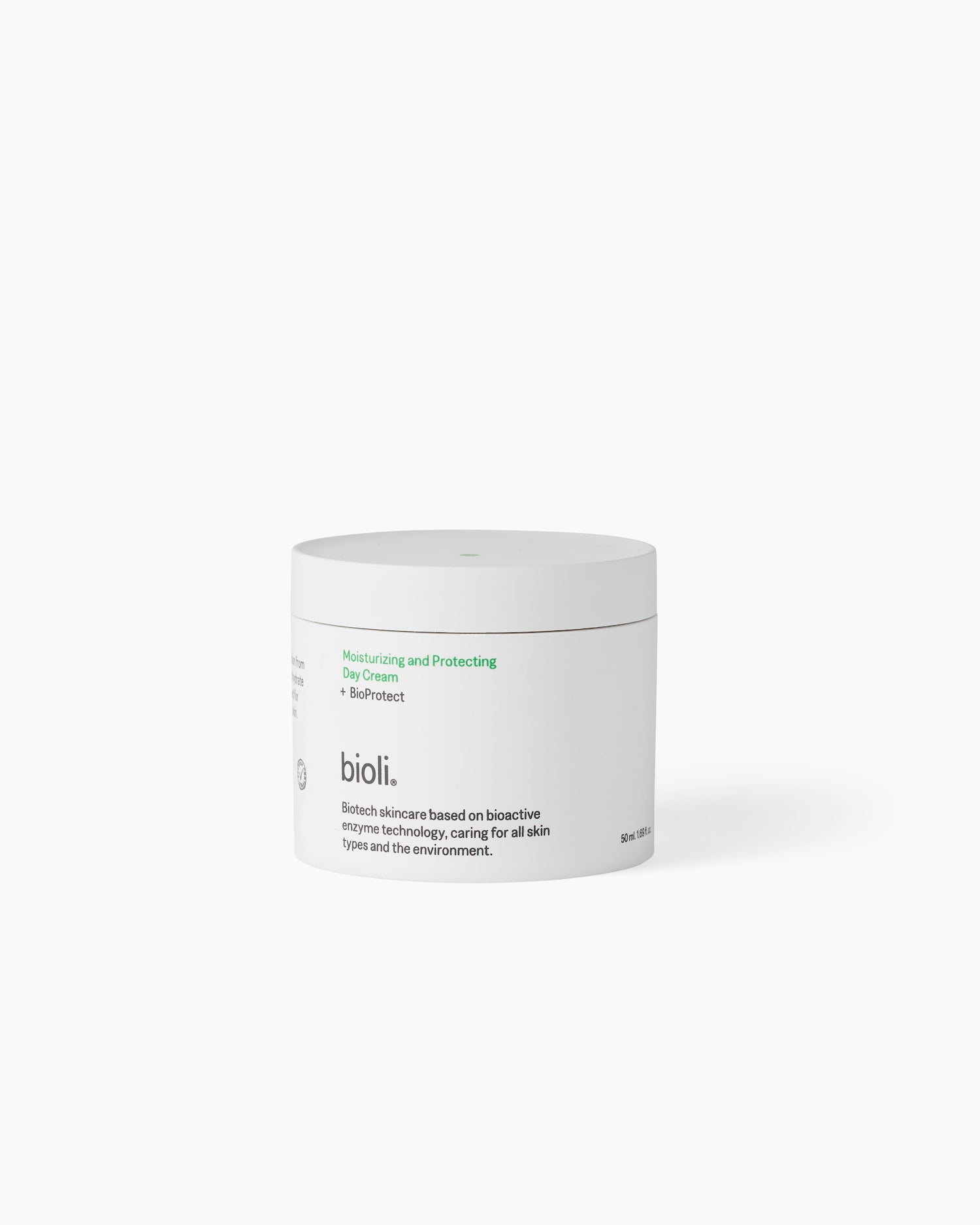
- Reduce exposure to oxidative stress – Oxidative stress becomes a bigger problem for skin as estrogen — which normally helps protect keratinocytes and fibroblasts from this kind of cellular damage — declines. Left unaddressed, oxidative stress helps trigger the same enzymes that break down collagen, so antioxidant support like superoxide dismutase (SOD) can help intercept that process before it accelerates. You can find SOD (INCI: Superoxide Dismutase) in Bioli's Moisturizing and Protecting Day Cream.
- Barrier protection – A weakened skin barrier needs gentle products that won't irritate it further. Lower levels of lipids and structural proteins, plus a more alkaline surface pH, make skin more easily irritated and slower to recover — so it's worth choosing fragrance-free formulas and being cautious of “natural” or “organic” labelling, since plant-derived ingredients can vary widely in composition and are a common source of allergic reactions. Bioli’s Clarifying Cleanser and Exfoliator provides gentle fragrance-free daily cleansing, with optional gentle enzyme-based exfoliation when the skin needs a little more.
-
Barrier strengthening – Hyaluronic acid works by binding and holding onto water. Using multiple molecular weights allows hydration to be delivered across different depths of the skin — some sit on the surface to support the barrier, while others penetrate more superficial layers for deeper, longer-lasting hydration. Explore two effective biotech-derived versions: Acetylated hyaluronic acid (INCI: Sodium Acetylated Hyaluronate) and Multi-weight, full-spectrum hyaluronic acid (HA) (INCI: Sodium Hyaluronate).
-
Screen skincare ingredients carefully – The most popular ingredients are not necessarily what's best for your skin. Traditional niacinamide, for example, is derived from nicotinic acid, which can trigger flushing and redness, a particular concern for skin that's already more prone to redness during these life stages. Fermentation reduces this compound, offering similar skin-tone-evening and barrier-supporting benefits with less risk of triggering a reaction. Learn more about Fermented niacinamide (INCI: Sphingomonas Ferment Extract) and find it in Bioli's Strengthening Serum.
- Nourish your skin's microbiome – As sebum production declines, so does one of its supports for the skin's microbial community, and beneficial organisms may become less abundant. Ingredients formulated to support microbiome balance, and reinforce the skin's barrier, like Bioactive Peptides (INCI: Acetyl heptapeptide-4), can help offset some of this shift. You can find bioactive peptides in Bioli's Strengthening Serum.
- Reduce the risk of inflammation – An already-elevated inflammatory background – partly driven by increased oxidative stress and the loss of estrogen's protective effects – may make skin's mast cells more reactive to additional triggers, including common allergens and fragrance compounds found in skincare. Choosing rigorously tested, low-allergen formulations is one practical way to avoid adding to that reactivity. Looking for products with the AllergyCertified label is the most reliable way to account for this, with this certification being the most rigorously tested in Europe.
Steps you can take – Beyond skincare
All recommendations come from The European Menopause and Andropause Society (EMAS) Guidelines and Education - Menopause Essentials.
- Stay physically active – EMAS notes 150–300 minutes of weekly moderate exercise, plus strength training twice a week, supports cardiovascular, bone, and mental health through the transition.
- Favor a Mediterranean-style diet – EMAS notes a Mediterranean-style diet may ease hot flashes short-term and support cardiovascular and bone health long-term. Examples of foods considered part of a Mediterranean diet include: fruit and vegetables, beans and seeds, olive oil and nuts, dairy products focused on cheese and yogurt, eggs and fish, some meat, usually poultry (chicken), rabbit, lamb, or goat. If you’re interested in the impact of diet on skin, have a look at our Guide: What to eat for better skin, combatting acne and eczema.
- Limit ultra-processed foods – EMAS cites research linking higher intake of ultra-processed foods to more intense menopausal hot flushes, alongside broader cardiometabolic risks.
- Talk to your doctor about menopausal hormone therapy (MHT) – MHT replaces declining estrogen, and current guidance recommends transdermal estradiol for vasomotor symptoms (e.g. hot flushes) in particular. If you think that this option could help you, it’s important to discuss suitability with your doctor.